
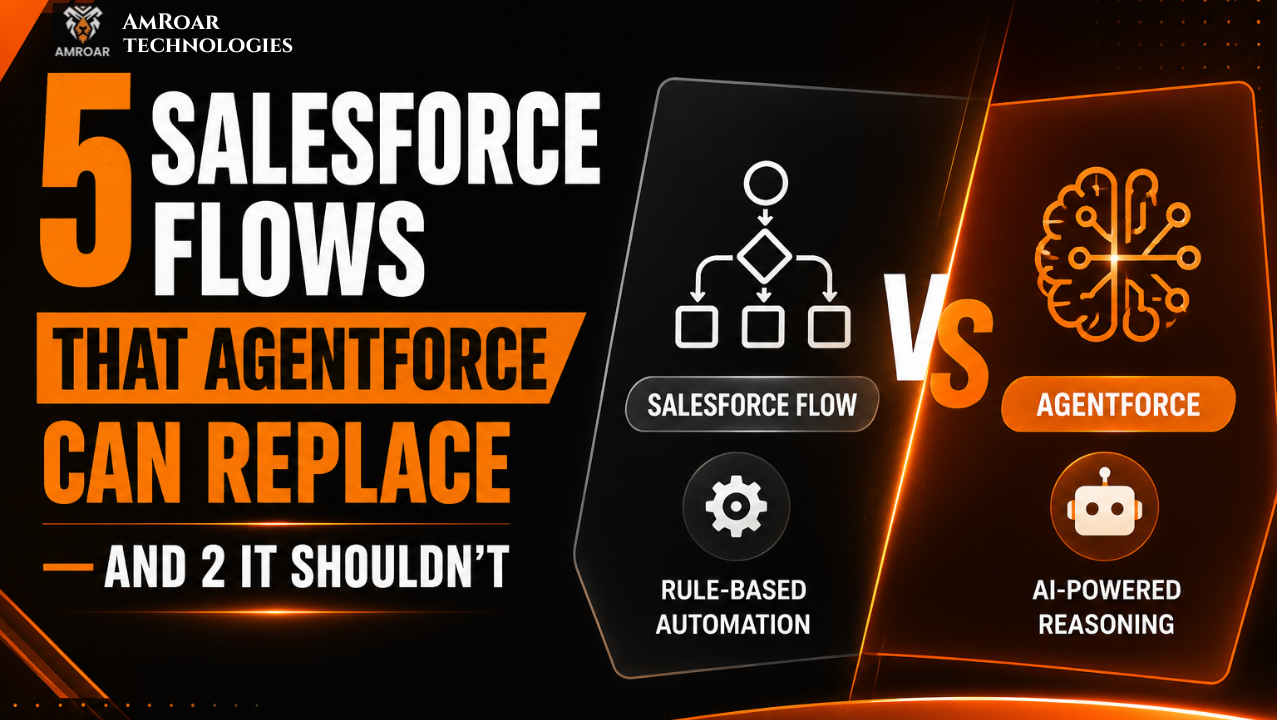
5 Salesforce Flows That Agentforce Can Replace — And 2 It Shouldn’t
Introduction
Every Salesforce admin has a version of the same moment lately. Someone in a leadership meeting asks, “should we just move everything over to Agentforce?” The honest answer is: some of it, yes. Not all of it. Not yet, and maybe not ever, depending on what the automation actually does.
That’s really what the Agentforce vs Salesforce Flow question comes down to. It’s not “old technology versus new technology.” Flow still runs a huge share of what makes Salesforce orgs actually work day to day. It isn’t going anywhere. Agentforce adds a genuinely different capability on top — reasoning, not just rule-following. The real skill isn’t picking a side. It’s knowing which tasks belong where.
This guide walks through the five clearest Agentforce vs Salesforce Flow use cases. It also covers two you should leave exactly where they are, plus a practical way to think through Agentforce vs Salesforce Flow going forward.
Why Everyone Is Talking About Agentforce
Salesforce Agentforce has dominated the conversation for good reason. It’s not a chatbot with a new coat of paint. It runs on a reasoning engine that looks at a situation, decides what needs to happen, takes an action, and checks whether that action actually worked. A genuine reason-act-observe loop, not a fixed script.
That distinction matters enormously once you’re actually comparing Agentforce vs Salesforce Flow directly. A traditional Salesforce Flow does exactly what it was built to do, every time, in the exact sequence it was configured for. That’s a strength when the task is predictable. It becomes a limitation the moment a situation falls slightly outside what the Flow was designed to handle. That happens constantly in real sales and service work.
Salesforce has also been shipping Agentforce updates at a genuinely fast pace, which keeps shifting the balance. Newer capabilities let agents trigger proactively on data changes and operate in the background of a business process, rather than waiting for someone to start a conversation. That shift is part of why the conversation has moved so quickly from “interesting AI feature” to “something we need an actual strategy for.”
Salesforce Flow vs Agentforce: What’s the Difference?
Understanding the difference starts with the basics. Salesforce Flow is rule-based automation. You define the trigger, the conditions, and the exact sequence of steps. If X happens, do Y. Salesforce Flow is precise, predictable, and completely transparent. Anyone can open it and see exactly what it will do in any given scenario.
Agentforce works differently, which is really the whole story here. Instead of following a fixed sequence, an Agentforce agent reasons through a situation using context, available data, and a defined set of actions it’s allowed to take. It can handle variation Salesforce Flow can’t. A customer phrasing a request in an unexpected way. A situation with multiple valid next steps. A task that genuinely requires judgment rather than a lookup table.
The honest way to frame Agentforce vs Salesforce Flow isn’t “which is better.” It’s “which kind of task is this.” In the end, it comes down to this: Flow is built for certainty, Agentforce is built for ambiguity. Most Salesforce automation strategies need both, working side by side, not one replacing the other entirely.
|
Salesforce Flow |
Agentforce |
| Rule-based |
AI reasoning |
|
Predictable |
Context-aware |
|
Best for approvals |
Best for conversations |
| Low cost |
Additional licensing |
|
Deterministic |
Adaptive |
5 Salesforce Flows That Agentforce Can Replace
- Lead qualification and routing. A Flow routes a lead based on fixed rules — company size, region, source. Agentforce can actually read the lead’s context and cross-reference account history. It makes a genuinely better routing decision when the situation doesn’t fit a clean rule.
- Case triage and initial response. This is where the Agentforce vs Salesforce Flow comparison gets interesting for support teams. Traditional Flow-based case routing assigns based on category fields someone filled in. Agentforce can read the actual case description and understand what’s really being asked. It drafts an appropriate response and escalates only what genuinely needs a human — a meaningfully more accurate first pass.
- Follow-up and re-engagement sequences. This one favors Agentforce clearly. Another clear example: a Flow sends the same follow-up email on the same schedule regardless of context. Agentforce adjusts tone, timing, and content based on what’s actually happened in the relationship. No generic template firing on autopilot.
- Data enrichment and cleanup suggestions. Another useful data point. Flows can flag missing fields, but they can’t judge which missing data actually matters. Agentforce prioritizes what to enrich first based on what’s likely to affect a deal or support outcome. It doesn’t treat every gap equally.
- Meeting prep and account summaries. A final strong example. Manually built Flow-driven summary fields tend to become outdated fast. Agentforce pulls together a live, current summary of an account or opportunity on demand. It synthesizes recent activity instead of relying on a static field nobody remembered to update.
2 Flows You Should Keep in Salesforce Flow
- Approval processes. Here the Agentforce vs Salesforce Flow answer is clear-cut. Deal discounting, contract sign-off, expense approval — these need to be deterministic. There’s no ambiguity to reason through here. There’s a policy to enforce exactly, every time, with a clear audit trail. This is precisely where the Agentforce vs Salesforce Flow answer favors Flow staying in charge.
- Compliance-critical field updates. Another clean-cut Agentforce vs Salesforce Flow case. Anything tied to regulatory requirements, mandatory data capture, or audit logging belongs in Salesforce Flow. You want a rule that fires identically every single time, with zero variation. That’s the opposite of what makes Agentforce valuable elsewhere.
When to Choose Agentforce vs Salesforce Flow
The clearest way to decide between Agentforce vs Salesforce Flow is asking one question honestly. Does this task require judgment, or does it require consistency?
If the task benefits from reasoning — understanding context, handling exceptions, adjusting to circumstances — Agentforce is usually the better fit. If the task needs to be exactly the same every time, with no room for interpretation, Flow remains the right tool. Approval logic, compliance steps, and anything with legal or financial precision should almost always stay rule-based.
There’s also a practical, less philosophical factor in the Agentforce vs Salesforce Flow decision: cost and complexity. Agentforce licensing and setup carry more overhead than a standard Salesforce Flow. Reserving Agentforce for tasks where reasoning genuinely adds value keeps both the budget and the system sane. Applying it everywhere just because it’s new tends to backfire.
Best Practices for Combining Both
Treat the Agentforce vs Salesforce Flow question as complementary layers, not competing systems. A common, effective pattern: let Agentforce handle the judgment call, then hand off to Flow for the deterministic execution that follows. An agent might decide a deal needs expedited handling. It then triggers a standard Salesforce Flow to route it correctly and log the change consistently.
Audit your existing Flow library before adding Agentforce on top of it. A messy Flow environment doesn’t get better by adding AI. It usually gets worse, because Agentforce ends up reasoning against the same underlying data problems the Flows were already struggling with.
Start narrow. Pick one or two of the five Agentforce vs Salesforce Flow use cases above and implement it there specifically. Measure the actual outcome before expanding further. Teams that try to convert everything to Agentforce at once tend to lose the precision Salesforce Flow was providing. They don’t gain full confidence in the judgment Agentforce is meant to add either.
Final Thoughts
The Agentforce vs Salesforce Flow conversation isn’t really a competition. It’s a division of labor. Salesforce Flow remains the right tool for anything that needs to happen exactly the same way every time. Agentforce earns its place wherever a task genuinely benefits from reasoning through ambiguity instead of following a fixed script.
Get the Agentforce vs Salesforce Flow split right, and your Salesforce automation stack becomes more capable. It doesn’t become less predictable where predictability actually matters. Get it wrong — treating Agentforce as a universal upgrade — and you risk introducing unpredictability into processes that never needed it.
The businesses getting real value from this AI automation in Salesforce shift aren’t the ones that moved everything to Agentforce overnight. They’re the ones that looked honestly at each Salesforce Flow, asked whether it needed judgment or consistency, and built accordingly.
Not sure which of your Salesforce Flows are good Agentforce candidates? Book a free 30-minute consultation with a senior Salesforce architect, and we’ll map out exactly where AI adds value in your org and where it doesn’t. We also help teams with Salesforce AI implementation and broader Salesforce consulting services, so your automation stack stays both smart and stable.
Comments are closed