
Why Most AI Projects Fail Before They Reach Production (And How to Avoid It)
There’s a meeting that happens in almost every company that gets serious about AI implementation. Someone presents a proof of concept. The demo works. Leadership gets excited. Budget gets approved. And then — six, eight, twelve months later — nothing has shipped.
The pilot is still running. The data is still being “cleaned.” The vendor is still “finalizing the integration.” And the business is still doing manually what everyone agreed the AI would handle by Q2.
This isn’t a technology problem. The models work. The platforms are mature. What breaks isn’t the AI — it’s everything surrounding it.
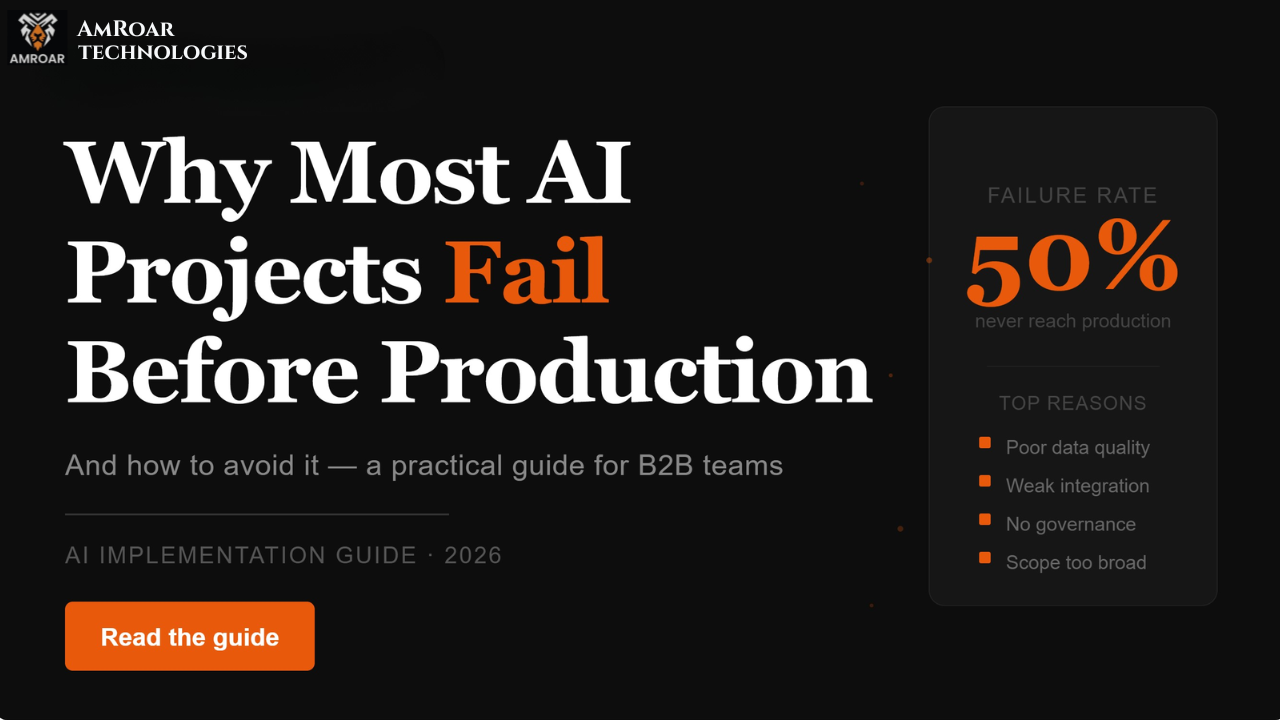
Industry studies consistently show that fewer than half of enterprise AI initiatives ever progress beyond pilot or proof of concept — despite significant and growing investment in AI technologies across almost every sector. The gap isn’t ambition. It’s execution. And understanding why AI projects fail starts with being honest about what actually breaks.
Whether you’re deploying an AI agent inside Salesforce Agentforce, Microsoft Copilot, HubSpot AI, or a custom LLM solution built on your own infrastructure, the same production challenges appear again and again. The specific platform changes. The failure patterns don’t.
What “Production” Actually Means
Before diagnosing the problem, it’s worth being clear about what production actually means — because a lot of teams think they’re further along than they are.
| Stage | What It Actually Means |
| AI Pilot | Limited test with controlled conditions and a small dataset |
| Proof of Concept | Working prototype in a sandbox, disconnected from real systems |
| Production Deployment | Live, connected to real data, used by real people every day |
| Enterprise-Scale AI | Production across multiple teams, governed and monitored at scale |
The gap between a working proof of concept and a live production deployment is where most AI projects go to die. And it’s almost never because the model wasn’t good enough.
Why AI Projects Fail Before They Reach Production — The 7 Real Reasons
1. No Clear Business Problem
This is the number one reason why AI projects fail — and nobody admits it upfront.
Teams get excited about AI implementation and start building before defining what problem they’re actually solving. The use case is vague — “improve efficiency” or “enhance customer experience” — and because it’s vague, there’s no way to measure success, no clear owner, and no natural finish line.
AI works best when it’s solving something specific. Not “make sales better” — more like “reduce the time a sales rep spends logging call notes by 80%.” Specific. Measurable. Owned by someone. Without that clarity, the project drifts indefinitely.
2. Poor Data Quality
You can have the best AI model available and it will still fail if the data feeding it is inconsistent, incomplete, or outdated. Vendors don’t emphasize this enough in demos because demos use clean data. Production systems use the data your team has actually been collecting — duplicate records, missing fields, inconsistent formatting, years of shortcuts that made sense at the time.
Data readiness is a prerequisite for AI implementation, not a parallel workstream. If the data isn’t ready before you build, the model won’t be reliable after you ship.
3. Weak CRM and System Integration
AI doesn’t live in isolation. Platforms like Salesforce, HubSpot, Microsoft Dynamics, and SAP are often where AI delivers the most value — but only when they’re properly integrated into the AI layer from the start, not connected as an afterthought six weeks before go-live.
This is where a significant number of AI deployment projects break down. The model works perfectly in testing, but when it’s time to connect it to a live CRM or pull real-time data from an ERP, the integration is missing, brittle, or simply wasn’t scoped properly. At that point the AI is working with stale data, can’t trigger actions in the systems that matter, and requires manual intervention to bridge gaps that should be automated. You’ve added complexity without removing work — the opposite of the point.
4. Trying to Automate Everything at Once
There’s a version of AI ambition that sounds bold in a boardroom and falls apart in execution. One team wants an AI agent for lead scoring. Another wants automated support routing. A third wants forecasting. Someone in leadership wants a single agent that handles all three. The scope expands, the dependencies multiply, and nothing ships.
Successful AI automation starts with one use case. One workflow. One team. Get that working, measure the impact, then use that proof point to fund the next phase.
5. No Change Management
AI doesn’t just change processes — it changes how people work. And people don’t automatically embrace that, especially when they weren’t involved in the decision.
The pattern is predictable: an AI agent gets built, gets deployed, and gets quietly ignored by the team it was supposed to help. Not because it doesn’t work, but because nobody explained why it was introduced, what it changes about their daily workflow, or what to do when it produces an unexpected result. Adoption has to be designed into the AI implementation plan from day one — not delivered as a training session the week before go-live.
6. Security and Compliance Ignored Until Too Late
In regulated industries — healthcare, financial services, legal — and in any company handling sensitive customer data, security and compliance aren’t optional considerations. They’re prerequisites.
Projects that treat security as a final checklist item before launch regularly get stopped at that stage. An AI agent that hasn’t been reviewed for data privacy compliance, access controls, or audit logging isn’t production-ready regardless of how well it performs technically. These questions are significantly cheaper to answer before you build than after.
7. No Governance or Continuous Monitoring
Without a governance framework, nobody can answer basic questions once the AI is live. Who owns the model? Who approves changes to how it behaves? What happens when it produces an output nobody expected?
And without continuous monitoring, a system that worked in month one quietly underperforms by month six as data patterns shift, business conditions change, and edge cases accumulate. Going live isn’t the finish line. It’s where the real operational work starts.
Signs Your AI Project Is Already at Risk
These are the warning signs that explain why AI projects fail before they ever reach production:
- No defined success metrics — nobody can say what “working” looks like
- CRM or operational data is known to be inconsistent or incomplete
- No implementation roadmap with milestones and clear owners
- Manual processes haven’t been mapped or stabilized before automating them
- Multiple disconnected systems that will all need to integrate with the AI
- Compliance and security haven’t been scoped yet
- No plan for what happens after go-live
None of these are fatal. All of them are fixable. But they’re much cheaper to fix before you build than after.
AI Readiness Checklist
Before starting any AI implementation, run through this honestly:
- Data ready — CRM and operational data is clean, complete, and consistently structured
- Systems integrated — Core platforms like Salesforce or HubSpot are connected and actively used
- APIs available — Key systems have accessible APIs for integration
- Leadership support — An executive owns the outcome, not just the budget
- Security plan — Data access, privacy compliance, and audit requirements are scoped upfront
- Governance defined — Ownership, approval processes, and monitoring responsibilities are clear
- KPIs set — Success metrics are specific, measurable, and agreed upon before the build starts
If more than two of these are unchecked, the project isn’t ready to build yet. That’s not a failure — it’s information that saves months of rework.
What This Looks Like in Practice
Customer Support AI Agent
A mid-size B2B company was handling hundreds of support inquiries weekly through manual triage. Response times were slow, escalations inconsistent, and the team was stretched thin. Rather than automating everything at once, they started with one workflow: routing incoming inquiries to the right team based on content and customer history. The AI agent connected directly to their CRM, pulling live customer data and logging every interaction automatically. Response times dropped significantly, the team shifted focus to complex cases that needed human judgment, and service quality became measurably more consistent. That result funded every phase that followed.
Sales AI Agent
A SaaS company’s sales team was spending a disproportionate amount of time on manual CRM updates — logging calls, updating deal stages, drafting follow-up emails. They deployed an AI agent integrated with Salesforce that handled routine logging and drafted follow-ups based on call transcripts. Reps went from spending roughly two hours a day on admin to under thirty minutes. Pipeline visibility improved because data was being captured consistently instead of selectively. The AI didn’t replace the sales team — it removed the part of their job that didn’t require them.
Invoice Processing Automation
A professional services firm was processing invoices manually across three different systems, none of which talked to each other. An AI automation layer was built to extract invoice data, match it against purchase orders in the ERP, flag discrepancies, and route exceptions to the right person for review. What had taken a team of three several days per month now completed in hours with minimal human intervention. The key was getting the ERP integration right before building the AI layer — not the other way around.
In all three cases, the reason the AI implementation worked wasn’t the model. It was that the data was ready, the integrations were solid, and the scope was tight enough to actually ship.
Final Thoughts
Why AI projects fail is rarely about the technology. They fail because organizations skip the foundational work — clean data, proper system integration, defined scope, governance, and adoption planning — and expect the model to compensate for what wasn’t built underneath it.
The companies getting real value from AI right now aren’t the ones who moved fastest. They’re the ones who were honest about what needed to be fixed before they could build — and who treated AI implementation as an architectural decision, not a product purchase.
Before investing in AI development, the most valuable thing most organizations can do is a structured readiness assessment — an honest look at CRM data quality, system integration gaps, automation readiness, and governance requirements before committing to a build. If your CRM foundation isn’t solid, whether that’s Salesforce or HubSpot, the AI layer built on top of it won’t hold either.
For teams evaluating AI agents specifically — whether that’s Agentforce, a custom LLM, or an automation layer connecting your existing systems — the integration architecture matters as much as the model itself. That’s where most enterprise AI projects either succeed or stall.
Amroar works with B2B teams at exactly this stage. Our AI Readiness Assessment identifies the gaps in your CRM, integrations, data quality, and automation strategy before you commit to building anything — so the investment goes into a system that actually reaches production, not another proof of concept that stalls at the finish line.
Book a Free AI Readiness Assessment →
Comments are closed