
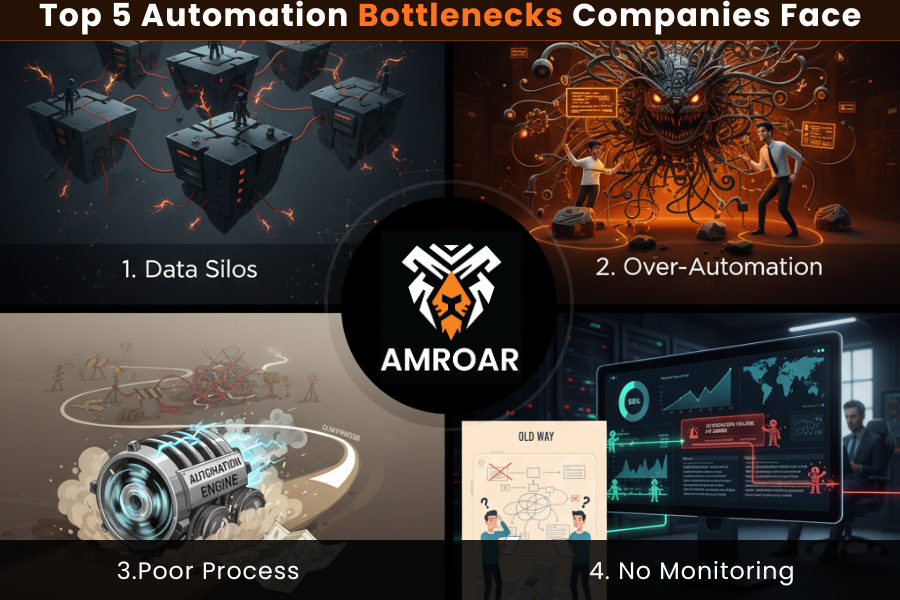
Top 5 Automation Bottlenecks Companies Face
Introduction
We live in a world where automation is supposed to make life easier — reduce repetitive work, speed up decisions, and free teams to focus on strategy.
Yet for many businesses, the reality looks different.
Systems don’t talk to each other. Teams still rely on spreadsheets. Automations fail silently in the background. And what was meant to save time starts creating more work instead.
That’s not a technology problem — it’s a process problem.
At the heart of every successful company is business process automation done right: workflows that actually work for people, not against them. But between growing tech stacks and evolving teams, bottlenecks sneak in.
Let’s look at the five biggest automation bottlenecks companies face — and how you can fix them before they hold your business back.
1. Disconnected Systems and Data Silos

Your sales team logs deals in Salesforce, your marketing team runs campaigns in HubSpot, and your operations team tracks fulfillment in Excel. Three islands. No bridges.
When systems are unable to intercommunicate, that is when automation stops working. Workflows require accurate data to operate, and without information being passed between platforms, decisions get delayed, reports mislead, and opportunities fall between the cracks.
The Fix
Centralize your data – make one platform the single source of truth, usually Salesforce or your CRM.
Use integration tools: Platforms like N8N or Make.com hook multiple apps with functionality that creates automatic data flow.
Keep it clean: Automated workflows are only as good as their data. Regular audits of data prevent automation from propagating errors.
Pro Insight: Companies decrease manual reporting time by 40% once they effectively integrate their systems. That’s the real power of smart business process automation-fewer silos, more speed.
2. Over-Automation and Unnecessary Complexity

We’ve all met that one system admin who proudly says, “Don’t worry, I automated everything!”
But sometimes, “everything” is too much.
When companies automate without strategy, they end up with overlapping triggers, conflicting rules, and endless notifications. The result? Confusion, slow performance, and endless maintenance headaches.
Automation is meant to simplify, not suffocate.
The Fix
- Start small, scale smart — Focus automation on high-impact areas first: lead assignment, reporting, or approval workflows.
- Review regularly — Quarterly automation audits help identify what’s outdated or redundant.
- Keep documentation — Record what each workflow does and who maintains it.
Pro Insight: The best business process automation feels invisible — things just work. If you’re constantly fixing or explaining your automations, it’s time to simplify.
3. Poorly Defined Processes Before Automation

Here’s the truth no one likes to admit: If your process doesn’t work manually, automation won’t fix it.
Many companies rush into automation because “it’ll save time.” But they skip the crucial step of defining how the process should work in the first place. Without clear ownership, steps, and exceptions, you are just automating chaos.
The Fix
Map it first. Draw your process. Identify steps, decision points, and inputs.
Clean up inefficiencies: Remove redundant approvals and unnecessary data entry.
Automate only after validation – run it manually once to make sure it works as it should.
Think of automation as the engine — but your process is the map. Without the map, the engine just spins in circles.
4. Lack of Monitoring and Continuous Improvement

One of the most common traps companies fall into: They “set it and forget it.”
Automation is not a one-time project. APIs change, teams evolve, and business rules change. Without monitoring, workflows break silently. And the damage adds up over time.
You may not even know that an automation failed until a customer calls and asks why their order was never processed.
The Fix
Use monitoring dashboards: set up real-time alerts when an automation fails or an API returns an error.
Regularly review the logs. Weekly or monthly check-ins catch small issues before they become major.
Measure the impact: Track key metrics like a success rate, time saved, and error reduction.
Pro Insight: Continuous improvement is not optional.
Healthy business process automation grows and evolves with your business. Treat every failure as feedback, not frustration.
5. Lack of User Training and Change Management

Even the most perfectly built automation will fail if your team doesn’t know how to use it — or worse, doesn’t trust it.
Automation changes how people work. It can feel intimidating or threatening if not introduced the right way. Many employees still prefer the “old way” simply because they don’t understand the new one.
The Fix
Communicate early: explain what’s changing and why it helps.
Train with empathy: provide hands-on workshops, not just documentation.
Create automation champions: find early adopters who can lead others.
Listen actively: obtain user feedback, analyze it, and sharpen the workflows.
Pro Insight: Automation success depends on people just as much as it does on technology. When your team understands how automation helps them, adoption rates soar, as does the ROI.
Measuring the Success of Your Automation
Once you have addressed those bottlenecks, it is now time to measure progress. The data will tell the story of your business process automation.
Key Metrics to Track
Process Efficiency: How much time each of the automated processes is saving.
Error Rate: Compare before and after automation; it should be much lower. Adoption Rate: What % of your team actively uses the automation workflows?
Return on Automation: Calculate the return based on time saved and cost reduced.
Pro Insight: When automation is working well, your teams feel the difference-less firefighting, more focus, and faster outcomes.
Why These Bottlenecks Keep Happening
These automation roadblocks persist even in tech-savvy companies because they are due to human behavior rather than system flaws.
People resist change.
Teams prioritize urgent work over strategic cleanup.
And sometimes, businesses simply grow faster than their systems can keep up.
It’s not more software that’s the solution. It’s the balance between technology and people, automation and adaptation.
That’s what effective business process automation really means: harmoniously bringing together human expertise and digital precision.
Looking Ahead: The Future of Automation
The next wave of automation goes even further than “if this, then that.” Thanks to AI and machine learning, systems will predict outcomes and make decisions proactively. For instance, instead of your CRM simply assigning leads, it could prioritize them based on the likelihood of conversion. Instead of your analytics dashboard reporting numbers, it might recommend next actions. But everything is irrelevant if your foundation itself is weak. Fix the bottlenecks now, and be ready to embrace intelligent automation tomorrow.
Conclusion
Automation isn’t about replacing people. It’s about giving them the freedom to do meaningful work.Automation bottlenecks do happen to any company, no matter how advanced. Awareness, discipline, and the ability to change start the process.
When your data is clean, your workflows are simple, your people are trained, and your automations are monitored, then business process automation is a true growth engine, not a hidden drain.
At Amroar Technologies, we assist organizations in smoothing out their operations, connecting their systems, and building automation that truly works. Whether you’re struggling with disconnected platforms or underperforming workflows, our experts help you identify the bottlenecks that matter and design solutions that last.
Because automation isn’t just about doing more-it’s about doing better.
Comments are closed