
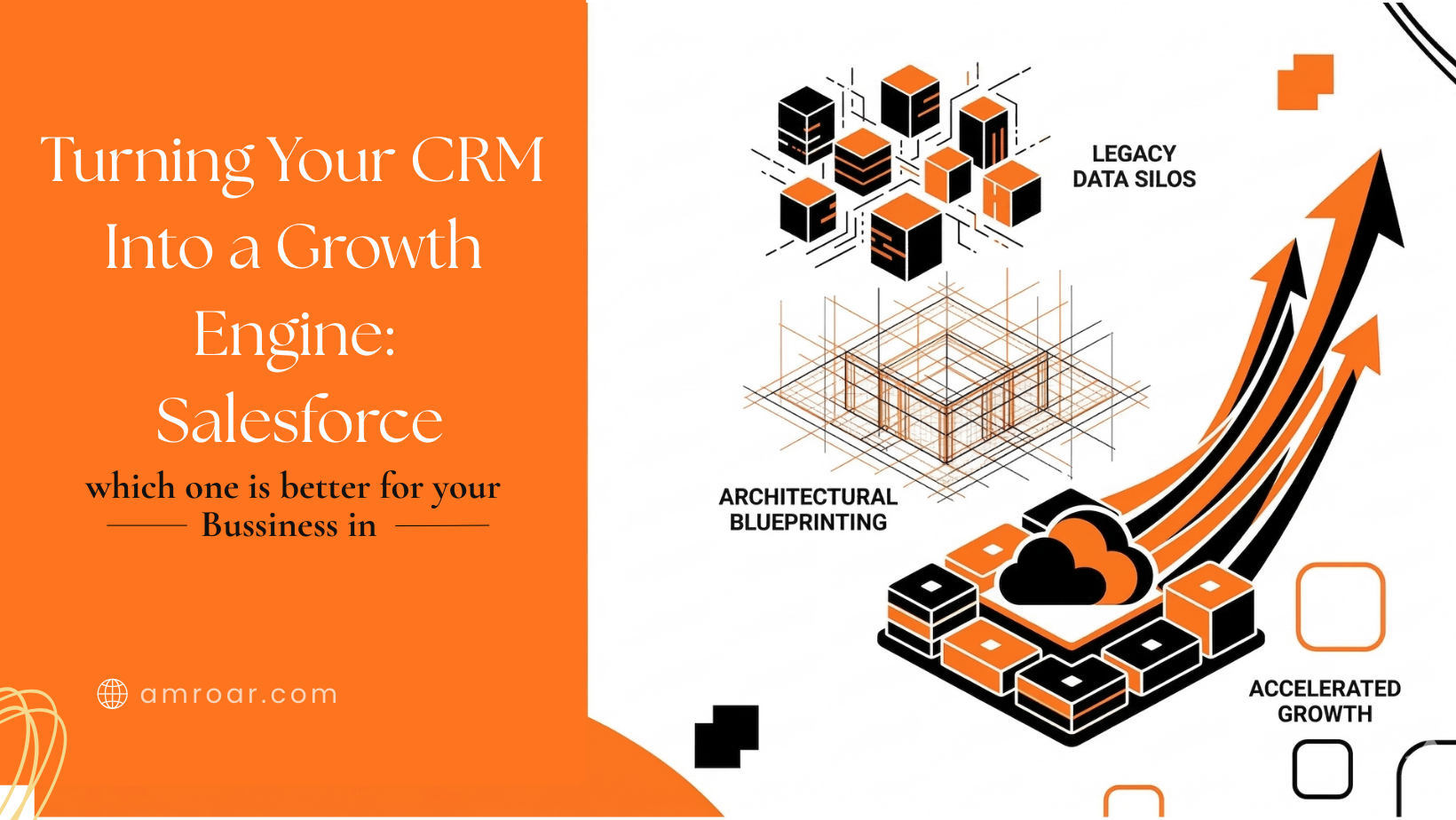
Turning Your CRM Into a Growth Engine:
The Real Case for Architecture-Led Salesforce Transformation
Executive Summary
I’ve spoken with dozens of business leaders who share the same quiet frustration: we spent a fortune on Salesforce, and honestly, it still doesn’t feel like it’s working the way it should.
That feeling is more common than most people admit. And the reason it keeps coming up isn’t what most people expect — it’s rarely the platform itself. Salesforce is, by any reasonable measure, a remarkable piece of software. The issue, almost every single time, is the foundation it’s sitting on.
CRM platforms have changed beyond recognition over the past decade. What started as a way to track contacts and log calls has become the operational spine of modern enterprise — connecting sales teams, service desks, marketing functions, and data infrastructure into a single, living ecosystem. When that ecosystem is healthy, you feel it everywhere. When it isn’t, the dysfunction is just as pervasive.
The frustrating truth is that most organizations experiencing CRM underperformance aren’t dealing with a technology problem. They’re dealing with an architecture problem. Their platform grew faster than the thinking underneath it did. Teams bolted on customizations. Integrations were stitched together under deadline pressure. Governance was an afterthought. And now, years later, they’re maintaining a system that’s too fragile to change quickly and too expensive to leave behind.
Amroar was built for exactly this situation. As a Salesforce consulting firm that puts architecture at the center of everything, Amroar helps enterprises redesign their CRM foundations — not just fix what’s broken, but build something that can genuinely scale, adapt, and keep delivering value as the business evolves.
Across a wide range of enterprise transformation engagements, the pattern of outcomes has been consistent. Organizations that take an architecture-led approach to Salesforce modernization have seen:
- Return on investment reaching up to 260%
- Net business value exceeding $5 million over three years
- Project timelines shortened by 35 to 40 percent
This report digs into why those results happen — and what it actually takes to achieve them.
CRM Has Outgrown Its Original Job Description
There’s a mental model that persists in some corners of the business world: CRM is where you log your calls and store your contacts. It’s a sales tool. Maybe a reporting tool. Important, sure, but not exactly foundational.
That model is about fifteen years out of date.
Today’s enterprise CRM platforms sit at the intersection of nearly everything — how you acquire customers, how you serve them, how you forecast revenue, how you run campaigns, how you manage partners, and increasingly, how you make decisions. Salesforce, in particular, has become less of a standalone product and more of a platform ecosystem that touches the entire customer lifecycle.
A properly configured Salesforce environment gives organizations a unified place to manage:
- Customer data, histories, and relationship context across every touchpoint
- Sales operations, deal management, and revenue forecasting
- Customer service workflows, cases, and resolution tracking
- Marketing campaigns, automation sequences, and engagement data
- Partner programs and ecosystem collaboration
- Analytics, performance dashboards, and executive reporting
- AI-generated insights, predictions, and automated workflows
The potential in that list is genuinely extraordinary. But potential and reality are two different things. Organizations that implement Salesforce without a coherent architectural strategy often end up with environments that are technically functional but strategically limited — data fragmented across siloed instances, workflows that don’t talk to each other, and a growing pile of custom code that makes every new initiative feel like defusing a bomb.
The platform can handle almost anything you ask of it. The question is whether the architecture underneath it is ready to ask.
Why Organizations Partner With Amroar
Companies come to Amroar at different moments in their journey. Some are starting fresh with Salesforce and want to do it right from day one. Others have been on the platform for years and are finally confronting the cost of accumulated technical debt. And some are preparing to modernize a CRM landscape that once served them well but no longer reflects how the business actually operates.
The common thread is a recognition that the stakes are too high to approach this casually. CRM transformation at enterprise scale touches every customer-facing function in the organization. Getting it wrong isn’t just expensive — it’s organizationally disruptive. Getting it right is genuinely transformative.
Platform Depth That Goes Beyond Certification
There’s a difference between knowing Salesforce and understanding it at the level required for enterprise architecture. Certifications matter, but they don’t tell you how to design a data model that will hold up under five years of growth, or how to structure an integration layer that won’t become a maintenance nightmare, or how to make governance decisions today that keep options open tomorrow.
Amroar’s team brings that deeper kind of expertise across the full Salesforce ecosystem — Sales Cloud, Service Cloud, Experience Cloud, Data Cloud, Einstein AI, Agentforce automation, MuleSoft integration, and enterprise architecture design. That breadth allows the team to see the whole picture, not just the immediate implementation challenge.
Shortening the Distance Between Investment and Value
One of the most consistent disappointments in enterprise CRM work is timeline drift. Projects that were scoped for six months stretch to twelve. Features that were supposed to go live in Q2 slip to Q4. Every delay has a real cost — not just the extended project spend, but the business value that was supposed to arrive with the new capabilities.
Amroar’s structured implementation frameworks are designed to compress that distance. Proven architecture patterns reduce decision-making uncertainty. Clear governance models prevent scope from drifting. The result, consistently, is project timelines around 40 percent shorter than conventional approaches — which means the business starts seeing returns sooner, and the total cost of the initiative comes in lower.
Keeping the Platform Clean
Technical debt in CRM environments has a nasty compounding quality. One poorly designed customization creates a dependency. That dependency limits what you can change later. When you need to change it anyway, you have to work around the dependency, which creates another one. Over time, the platform becomes a system of accumulated workarounds that everyone is afraid to touch.
Amroar’s approach is to fight that tendency from the very beginning — defaulting to platform-native capabilities wherever possible, treating custom development as a last resort rather than a first instinct, and designing integration layers with long-term maintainability in mind. The systems this produces are leaner, more stable, and dramatically easier to evolve.
Building a Foundation That’s Ready for AI
If there’s one thing that separates the organizations winning with AI from those still experimenting with it, it’s the quality of their underlying data architecture. Predictive models need clean, unified, well-governed data. Intelligent automation needs reliable integration layers. AI-powered customer experiences need CRM workflows that are consistent and well-structured.
None of that happens by accident. Amroar designs CRM architectures with AI readiness as an explicit design criterion — not something to retrofit later, but something built in from the start. When Salesforce releases new Einstein capabilities, new Agentforce automation tools, new AI-driven analytics features, Amroar’s clients are positioned to act on them immediately rather than spending months preparing the foundation first.
What This Looks Like in Practice
To make this concrete, consider a composite profile drawn from patterns seen across multiple enterprise engagements. This isn’t a single real company, but it reflects the kind of organization Amroar regularly works with — and the kind of results that architecture-led transformation consistently produces.
The Organization
- 10,000 employees
- 7,500 Salesforce users across the business
- Annual revenue of $3 to $5 billion
- Multiple divisions operating in different market segments
The Starting Point
Before the transformation program began, the CRM environment looked like what you get when a platform grows organically across a large organization without centralized architectural oversight:
- Multiple Salesforce instances running in parallel across divisions, with no unified customer view and significant data duplication
- Years of accumulated custom development that made even minor platform changes time-consuming and risky
- Customer data scattered across systems, making consolidated reporting nearly impossible to trust
- New Salesforce capabilities going largely unadopted because the existing environment couldn’t absorb them cleanly
- Platform maintenance consuming an increasing share of the IT budget with limited corresponding business value
The organization wasn’t mismanaging its CRM out of negligence. The platform had simply outpaced the architectural thinking behind it. The investment was significant — the infrastructure to support it properly hadn’t kept pace.
What the Transformation Program Set Out to Achieve
- Consolidate fragmented Salesforce environments into a coherent, unified architecture
- Dramatically reduce the custom development footprint and the technical complexity it created
- Build proper integration between CRM and the broader enterprise application landscape
- Establish data governance frameworks that made analytics actually reliable
- Prepare the platform to take full advantage of AI-driven automation capabilities
- Improve the experience for both customers and the internal teams serving them
Where the Financial Value Comes From
When CRM transformation is designed and executed with real architectural discipline, the returns are substantial — and they accumulate across several distinct value streams simultaneously.
Projects That Finish on Time — and Under Budget
When architecture decisions are made clearly at the outset and implementation follows proven patterns, the ambiguity that causes project delays largely disappears. Teams know what they’re building, how it connects to everything else, and what ‘done’ looks like. The result is project delivery that runs roughly 40 percent faster than conventional approaches — with corresponding reductions in project cost and earlier access to the capabilities being built.
Estimated benefit over three years: $1.5 million
Getting Working Software Into Hands Faster
There’s a meaningful financial difference between a minimum viable product that goes live on schedule versus one that arrives three months late. That gap represents three months of foregone value from service management tools, customer data capabilities, and workflow automation that teams could have been using. At enterprise scale, those three months add up quickly.
Estimated benefit over three years: $2.7 million
Protecting the Investment From Implementation Risk
Large CRM initiatives carry real implementation risk — cost overruns, failed go-lives, adoption failures, and systems that don’t deliver what was promised. It’s more common than the industry likes to discuss. Structured architectural governance and experienced implementation oversight can reduce the probability of those failures by around 50%. At the scale of investment this kind of program requires, that risk reduction has a very real dollar value.
Estimated benefit over three years: $900,000
Keeping Pace With the Platform
Salesforce ships improvements, new features, and AI capabilities on a regular cadence. Organizations with clean, flexible architectures can act on those releases in a fraction of the time it takes heavily customized environments — roughly 25 percent faster, based on patterns observed across engagements. Over time, that speed advantage compounds, keeping the organization’s CRM capabilities aligned with what the platform actually makes possible.
Estimated benefit over three years: $150,000
Lower Cost to Run the Platform Over Time
Simplified CRM environments cost less to operate, full stop. Less custom code means fewer things to break and fewer specialists needed to maintain them. Cleaner architectures mean simpler training, faster onboarding, and lower rework costs. Organizations that go through architecture-led modernization typically see ongoing CRM operating costs fall by around 30%. That’s not a one-time saving — it’s a permanent reduction in the cost structure of the platform.
Estimated benefit over three years: $2.8 million
The Benefits That Don’t Show Up in the ROI Model
The financial case is compelling enough on its own. But some of the most important outcomes from CRM transformation are the ones that resist being reduced to a number.
Customers Who Notice the Difference
When customer data is unified and CRM workflows are consistent across the business, the customer experience improves in ways that are genuinely felt. Interactions feel more relevant. Problems get resolved more quickly. There’s a coherence to the experience that customers appreciate, even if they can’t articulate exactly why. That coherence translates into retention, into referrals, and into the kind of customer relationships that are genuinely hard to compete with.
People Who Can Focus on Actual Work
Manual data entry, duplicated effort, workarounds for broken workflows — these things consume enormous amounts of time in organizations with poorly designed CRM environments. When those friction points go away, people get time back. Many organizations report employees saving close to two hours per week after a transformation. Across thousands of users, that’s a productivity dividend that shows up in output and morale alike.
Data That’s Actually Worth Trusting
One of the quieter costs of fragmented CRM architecture is the erosion of confidence in data. When teams can’t agree on whose numbers are right, decision-making slows down. Debates replace action. Modernized CRM architectures produce data that’s consistent, well-governed, and reliable — which means leadership can trust what they’re seeing and move faster on the strength of it.
Internal Teams That Can Keep Building
The best consulting engagements end with the client being more capable, not more dependent. Amroar invests deliberately in building internal capability throughout every transformation — training platform administrators, establishing governance practices that the internal team can own, and helping organizations create the internal centers of excellence needed to keep improving the platform long after the initial engagement is complete.
What This Actually Costs
There’s no point in being vague about investment requirements. CRM transformation at this scale is a significant undertaking, and the costs reflect that.
For the composite organization in this study, the investment broke down as follows:
- Salesforce consulting and architecture services: $2 million
- Internal project management, change management, and training programs: $300,000
- Total investment: $2.3 million
Against that investment, projected three-year benefits total approximately $8 million — producing a net business value of $5.7 million and a return on investment of 260%.
To put that another way: every dollar put into this transformation returned three dollars and fifty cents. That’s not incremental improvement. That’s the kind of return that changes how an organization thinks about the role its CRM can play in driving the business forward.
Financial Summary
- Total benefits over three years: $8 million
- Total investment: $2.3 million
- Net business value: $5.7 million
- Projected ROI: 260%
What Good CRM Strategy Actually Looks Like
For any organization evaluating where its Salesforce investment stands — or planning where it should go next — a few principles consistently separate the transformations that deliver lasting value from those that don’t:
- Start with Salesforce architecture, not features. The decisions that determine long-term CRM success are made before a single workflow is built — in how the data model is designed, how systems are integrated, and how governance is structured.
- Treat configuration as the default, customization as the exception. Custom development feels like the fast path in the short term and consistently proves to be the slow path over time.
- Build governance into the foundation. Trying to establish data governance and platform management practices after the fact is dramatically harder than designing them in from the beginning.
- Think about AI readiness now, not later. The organizations that will benefit most from CRM AI capabilities are the ones whose data architecture is already clean and connected — not the ones scrambling to prepare it after the AI tools arrive.
- Find consulting partners who think in systems, not just implementations. Technical deployment skill is necessary but not sufficient. The work requires partners who understand how enterprise architecture decisions ripple across the organization over time.
Final Thought
The organizations that get the most out of their CRM investments aren’t necessarily the ones with the biggest budgets or the most sophisticated technical teams. They’re the ones that made a deliberate decision to build the right foundation — and found partners who knew how to help them do it.
CRM transformation, done properly, isn’t a project. It’s a shift in how the business thinks about its relationship with its technology — from something that has to be managed and maintained to something that actively drives performance and makes the whole organization more capable.
The numbers in this report reflect real patterns from real enterprise engagements. A 260% return on investment. $5.7 million in net business value. Timelines cut nearly in half. These aren’t theoretical projections — they’re what happens when architectural discipline meets serious execution.
If your CRM feels like it’s holding the business back rather than pushing it forward, the gap between where you are and where you could be is almost certainly smaller than it feels. The path is well-traveled. The results are real. And the first step is simply deciding that the foundation deserves the same level of attention as everything built on top of it.
Discuss Your Salesforce Architecture
If your Salesforce environment feels more complex than it should — or if you’re unsure whether your CRM architecture is ready for the next phase of growth — it may be time for an independent architectural review.
Amroar works with enterprise organizations to evaluate CRM ecosystems, identify structural bottlenecks, and design transformation roadmaps that unlock the full value of the Salesforce platform.
Our architecture consultations focus on:
- CRM architecture health assessment
• Technical debt and customization analysis
• Integration and data architecture review
• AI and automation readiness evaluation
• Scalable Salesforce modernization strategy
Book a complimentary Salesforce architecture consultation with Amroar and receive an expert review of your current CRM foundation.
👉 Schedule your consultation with Amroar
Salesforce CRM Implementation: Timeline And Key Factors
[…] for it to actually go live while the business runs on spreadsheets and workarounds. Salesforce CRM implementation is a crucial step for businesses looking to streamline operations, improve customer relationships, […]