
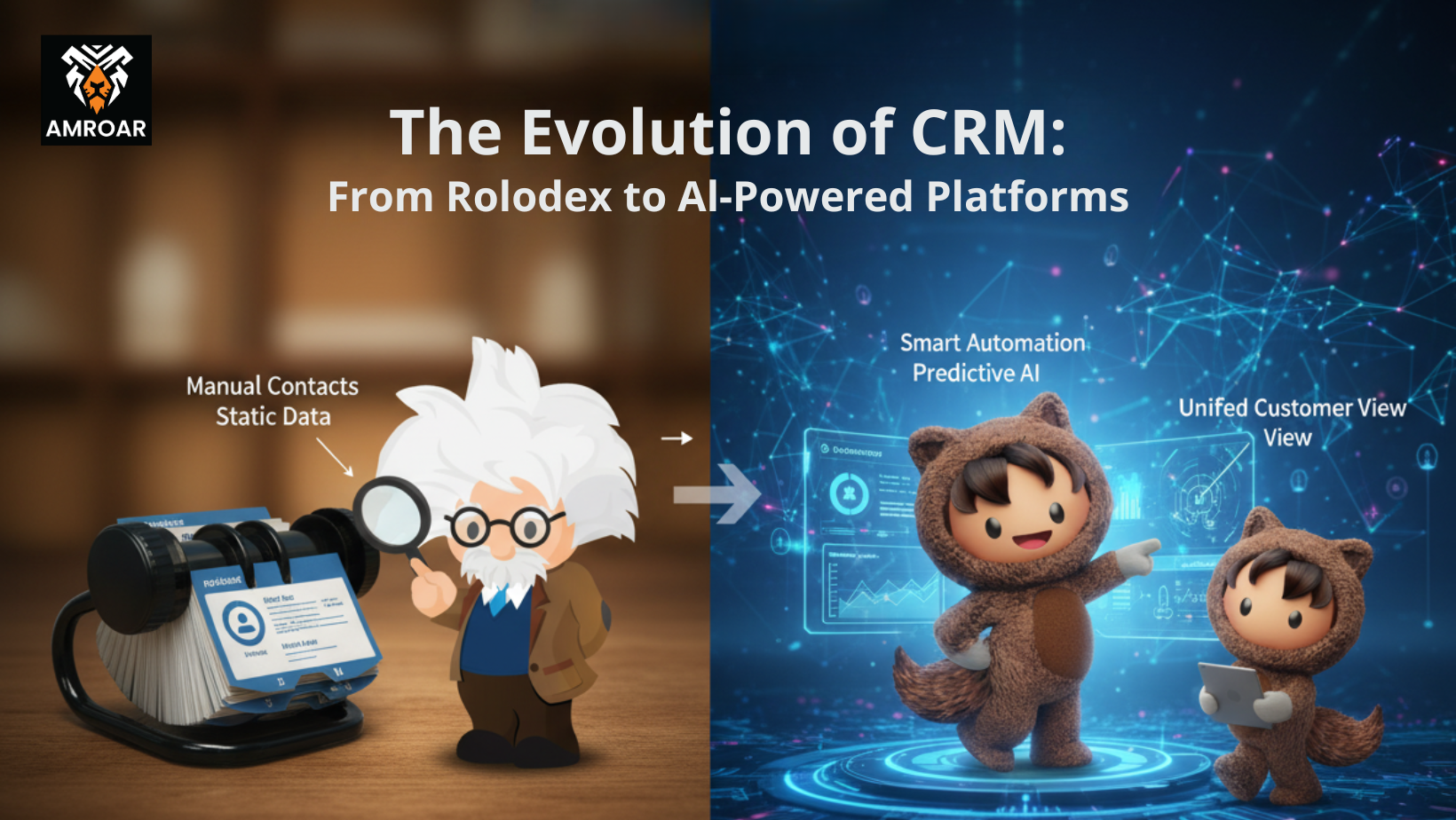
The Evolution of CRM: From Rolodex to AI-Powered Platforms
1. A Brief History of CRM
In the past, companies depended on physical Rolodexes, spreadsheets, or simple contact lists saved in computer software. Each meeting—from a handshake at a trade exhibition to a subsequent call—was documented done manually by hand. With the increase of sales teams and the increase in customer data, the shortcomings of these analog systems became evident: misplaced information, human mistakes, and an absence of a centralized customer perspective.
In the late 1990s, a need of digital systems appeared. CRM systems provided large organization but were oftenly complicated, costly, and restricted to businesses with valuable IT budgets. These local systems demanded expensive infrastructure, continuing maintenance, and regular upgrades. Still, they established the foundation for what would follow.
2. How Salesforce Revolutionized Cloud CRM
Then Salesforce came and changed everything. Introduced in 1999, Salesforce was the first to create cloud-based CRM, providing access anytime and anywhere, scalability, and a cohesive platform for all in one- sales, service, and marketing. The idea of Customer 360—integrating customer information across various departments—was released. Now Businesses no more longer had to struggle with infrastructure; Salesforce provided CRM that was accessible, powerful, and intelligent.
Salesforce’s creativity continued beyond that point. Using tools such as Einstein AI and Agentforce, it placed intelligence at the heart of customer interaction—simplifying recommendations, automatic replies, and even scheduling actions. In conclusion, Salesforce allowed companies to sell more smartly & intelligently, serve more quickly, and grasp more thoroughly.
3. Extending Salesforce with Make.com
Although Salesforce provides powerful capabilities, numerous organizations must integrate the every system of their ecosystem—ERP systems, marketing software, e-commerce platforms, and beyond. Discover Make.com: an automation system platform that does not requires any coding, and allowing teams to visually create and manage workflows that connect Salesforce with any application you need in just a few clicks.
Imagine generating a Salesforce record automatically when a form is filled by user and submitted on your site, causing a Slack notification on your system, and updating inventory in your ERP—all happens together without coding. That’s Make in effect. It’s like providing your Salesforce platform with independent wings, allowing for more intelligent, effortless operations just for you.
4. Modern Businesses & Full Tech Stacks
Modern companies uses more than a single tool—they depend on a comprehensive stack: CRM, marketing automation, service platforms, analytics, communication applications, and automation engines. Salesforce commonly operates as the central component of this stack, acting as the “source of truth” for client data and record. Enclosing it are resources for marketing engagement, chat assistance, invoicing, data analysis, and additional features.
Today’s organizations require this coordination to remain flexible—reacting to customer actions immediately in real time, automating daily routine tasks, and processing insights based on data. These integration-focused system and softwares remove barriers and allow teams to concentrate on strategy instead of manual tasks.
How Amroar Technologies Enables Salesforce-Centric Stacks
Amroar Technologies is a premier Salesforce consultancy— controlled by the top 5% of Salesforce professionals—providing expert implementations across Cloud platforms: Sales, Service, Marketing, Commerce, Data Cloud, and more. With more than 25 years of expertise in the niche, they provide quick and effective implementations that results in tangible outcomes.
Amroar not only implements Salesforce—they transform it into a revenue-generating software. They manage goal setting, planning, execution, launch, and continuous optimization with efficient processes and professional assistance. Amroar excels at establishing Salesforce Clouds and integrating with external systems.
When companies need simple and smooth automation and integration, Amroar utilizes Make.com to enhance Salesforce’s capabilities. Make’s no-code workflows prepares seamless links between Salesforce and different applications— working effective, automated procedures without any problem of custom development.
By taking advantage of this integrated strategy—Salesforce software, Make.com automation, and specialized integration, contemporary businesses can create completely coordinated tech stacks that increases efficiency, provide insights, and foster growth.
Why Businesses Must Embrace Salesforce + Automation to Stay Future-Ready
To stay in competitive market, companies must not hold on to manual processes or disconnected technology systems. Clients foresee immediate, customized interactions. Teams require broad, all-around data availability. Processes need to adapt to changing market demands.
By implementing Salesforce enhanced with automation through Make.com :
You remove monotonous tasks, allowing teams to concentrate on strategy.
You eliminate silos, attaining systematic customer perspectives across channels.
You scale effectively, implementing new procedures rapidly without spending to much.
You prepare operations for the future, equipped to implement AI agents or adapt to advancing tools.
Partnering with Amroar Technologies makes the journey to a future-ready CRM stack likely evident. Their extensive knowledge of Salesforce, along with powerful automation and thoughtful design, empowers organizations to succeed—both now and in the future
Comments are closed